
Social dance discovery guide
Jeju Hobbies for Foreigners: How to Find a Real Weekly Community (Including Bachata)
The searcher is in Jeju (already living there or arriving soon) and wants practical hobby options that actually happen week to week—ideally social and easy to join without deep Korean. This content should exist because most “hobbies in Jeju” results are generic attractions, one-off classes, or expat forum threads; readers need a way to verify recurring local activities and then decide whether social dance (specifically bachata) fits their routine using discovery evidence (posters + atmosphere up
Written and published by Social Dance Live
Published · Updated
You’re not really choosing between “fun” hobbies in Jeju—you’re choosing between hobbies that *actually run on a predictable cadence* and hobbies that disappear after one enthusiastic recommendation. If you want something that can turn into a weekly community, make your first decision based on proof you can verify: public posters and recent updates that show a real time, place, and format.
Pick a Jeju hobby that’s actually happening: the “proof-first” filter
Before you commit to any new hobby—language exchange, sports, dance, art—run a quick reliability check. The goal isn’t to find the “best” scene; it’s to avoid wasting evenings on plans that were never confirmed.
A proof-first filter is simple:
- Does it have a specific date and start time? A recurring activity usually publishes dates, not just “every week” in a comment thread.
- Does it name a location you can map or identify? Venue names (or at least a clear location tag) matter more than long descriptions.
- Is the format clear enough that you can show up appropriately? “Festival,” “workshop,” “class,” and “social” are different commitments.
- Can you see timely updates? A poster feed with fresh postings is a stronger signal than a static list.
Use this filter first, then decide what you feel like doing. It keeps you from building your schedule around vibes.
A simple way to compare hobby formats in Jeju (drop-in vs course vs recurring social night)
Once you’re using proof-first signals, the next decision is format. In Jeju, the most joinable options tend to fall into three buckets—each with a different level of commitment and a different “discoverability footprint” online.
1) Drop-in session (one-off or occasional). This includes single-day workshops, pop-up activities, or special events. It’s easy to try once, but harder to turn into a weekly routine unless you see it posted repeatedly. Online, drop-ins usually look like: one date, one start time, and no promise of the next one.
2) Short course (multi-week). Courses can be great for consistency, but you need more details up front—start date, progression, and whether late joiners are accepted (only trust what’s stated). A course is “reliable” when it’s posted clearly and repeatedly enough that you can tell it’s organized, not improvised.
3) Recurring social night (repeatable meetup format). This is the format most likely to create a weekly community—because it’s built around repeat attendance. The key is not assuming it exists, but confirming it through consistent postings and clear labeling (for example, a social listing versus a one-time workshop). Social dance often shows up in this bucket when posters and updates show a steady pattern.
This is where bachata can become a practical Jeju option—*when* you can verify that you’re looking at something that isn’t just a one-off.
When bachata makes sense—and how to confirm it in Jeju without knowing venue names
If you’re looking for an English-friendly hobby in Jeju, social dance has one big advantage as a discovery problem: it’s commonly advertised with posters that include the exact decision details (date, time, venue, and genre). You don’t need insider knowledge of neighborhoods or a friend group to begin your search—you need a feed where postings are organized and searchable.
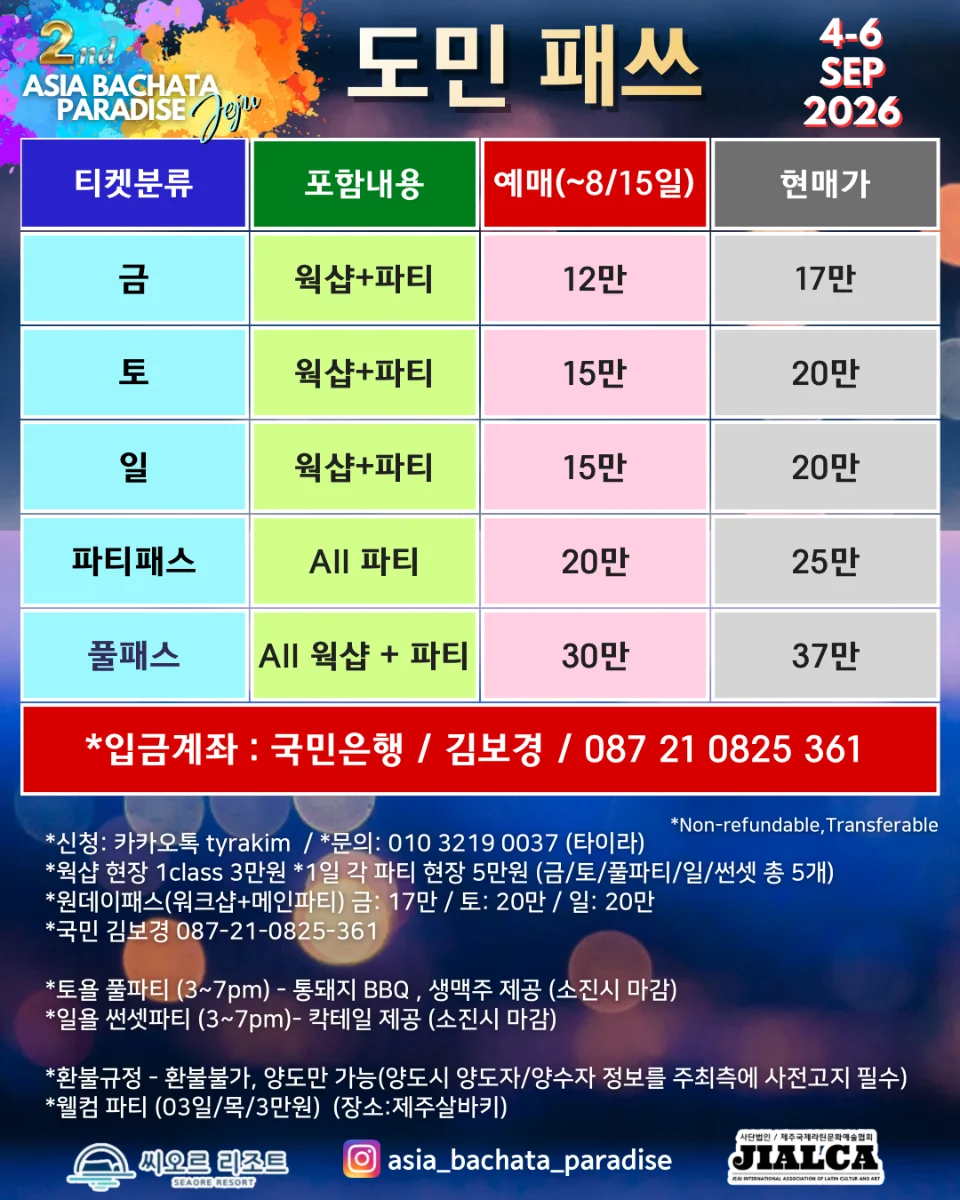
One concrete Jeju bachata listing you can verify right now is [제2회 아시아 바차타 파라다이스 (2026.9.4~9.6) 제주 바차타 페스티벌](/posters/2-bachata-2026-9-4-6-jeju-festival-do-2026-09-04-824f4cf6). It’s labeled as a festival / congress, the genre is bachata, it’s located in Jeju, South Korea, it starts Sep 4, 2026, 8:00 PM, and the venue is [제주 씨오르 리조트](/venues/south-korea-jeju-e65f2ec1).
That example matters even if you’re not planning around a festival date, because it shows what “proof” looks like in dance discovery: a listing that spells out format, time, and venue—enough information to decide whether it fits your calendar.
To find options that are more likely to support a weekly routine (rather than a single date), use a Jeju poster feed and search by genre instead of guessing venue names. The fastest path is [Browse related posters](/?location=Jeju&type=posters) and then narrow by what you’re actually willing to do on a weeknight: bachata, salsa, kizomba, zouk, tango.
As you browse, open individual posters and look for the signals that suggest repeatability:
- The listing clearly states class, social, workshop, or festival / congress.
- The posting pattern looks current (fresh posters and updates rather than a dormant page).
- The details are complete enough that you don’t need to DM someone just to know when and where.
This approach is especially useful as an English speaker: you’re not relying on long Korean explanations or forum threads—you’re using the same structured info locals use to decide.
Read the poster like a local: what to check before you go (8-point list)
Once you’ve found a dance listing (bachata or otherwise), your decision should come from what’s explicitly written—nothing more. A good poster typically gives you enough to decide whether to go *this* time, and what questions you still need to ask.
- Date and start time (and whether it’s a one-day listing or part of a date range)
- Exact location signal: a venue name or a clear location tag you can map
- Genre (bachata vs salsa vs kizomba vs zouk vs tango)
- Format: class vs social vs workshop vs festival / congress
- Level notes if stated (beginner, open level, etc.)
- Named identifiers such as teacher/DJ names (useful to match related postings without guessing)
- Language notes only if they’re explicitly written (don’t assume English-friendly unless stated)
- Contact or registration requirement if the poster indicates one
When those eight points are present, you can make a clean decision: go because the time/place/format fits your week, not because someone said it was popular. And when you don’t see those details, treat it as a sign to keep browsing until you find a listing that’s concrete enough to plan around.